Cedar Fever: Mountain Cedar Allergy Season, Symptoms and Care
- Cedar fever is an allergy to the pollen of Ashe juniper, a tree Texans call mountain cedar that isn't a true cedar (Texas A&M AgriLife).
- Cedar pollen usually starts in mid December, peaks in mid January and tapers off by early March (Texas A&M Forest Service).
- Despite the name, most people with cedar fever don't run a fever, and a temperature above 101.5 degrees points to something else (Cleveland Clinic, Texas A&M Forest Service).
- Mountain cedar pollen has been traced by DNA from Texas or Oklahoma to Ontario, Canada (PLoS One, 2017).
- A small 2020 trial found three lymph node injections of mountain cedar extract eased symptoms compared with placebo (Annals of Allergy, Asthma & Immunology).
Cedar fever is an allergic reaction to the pollen of the Ashe juniper, the tree most Texans call mountain cedar. It hits in winter, usually from mid December into early March, and it feels so much like a cold or the flu that many people don't realize it's an allergy. The worst of it is in the Texas Hill Country, but the pollen rides cold front winds far beyond it. If you feel miserable every January and never quite get sick, mountain cedar allergy is a strong suspect.
Allergy medicine helps while you take it. Allergy shots, allergy drops and ILIT (intralymphatic immunotherapy) work on the allergy itself, and one small trial of ILIT for mountain cedar was run in Texas. More on that below.
When to get care right away
For most people cedar fever means a stuffy nose and a rough few weeks. Asthma changes that. Cleveland Clinic notes that people with asthma can have wheezing, shortness of breath and chest tightness during cedar season.
Call 911 or go to the emergency room for extreme trouble breathing, severe shortness of breath while resting, or lips or a face turning bluish. MedlinePlus also lists confusion or drowsiness and severe chest pain. If a cough or breathlessness keeps getting worse, the ACAAI says to get medical treatment right away.
What mountain cedar really is
Mountain cedar is Ashe juniper, Juniperus ashei. Texas A&M AgriLife is plain about it: the tree is often called cedar but isn't a true cedar. It's in the cypress family. "Cedar" stuck as the local name, which is why the illness is cedar fever and not juniper fever. If you search for an Ashe juniper allergy or juniper pollen allergy, you're looking at the same thing.
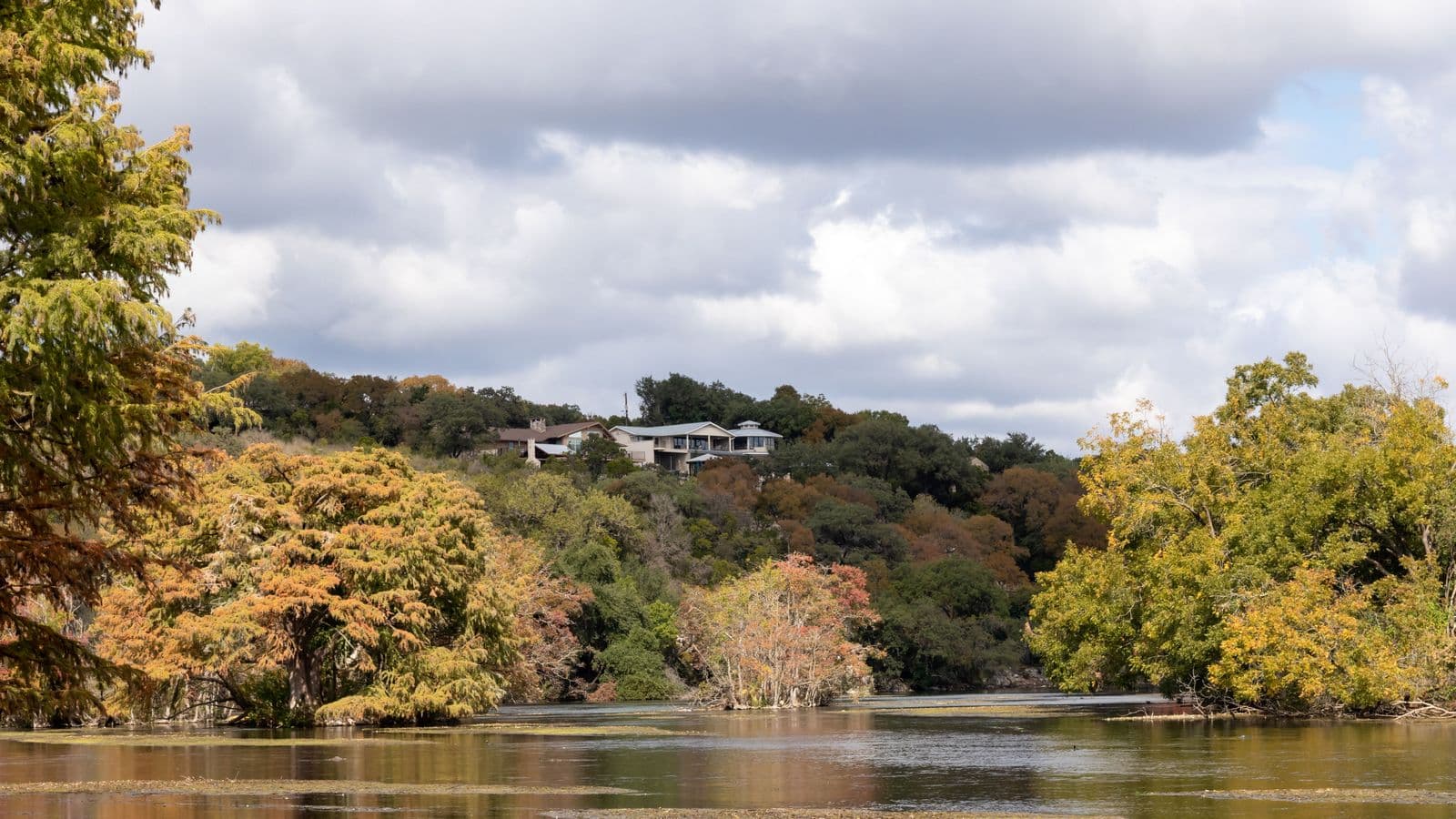
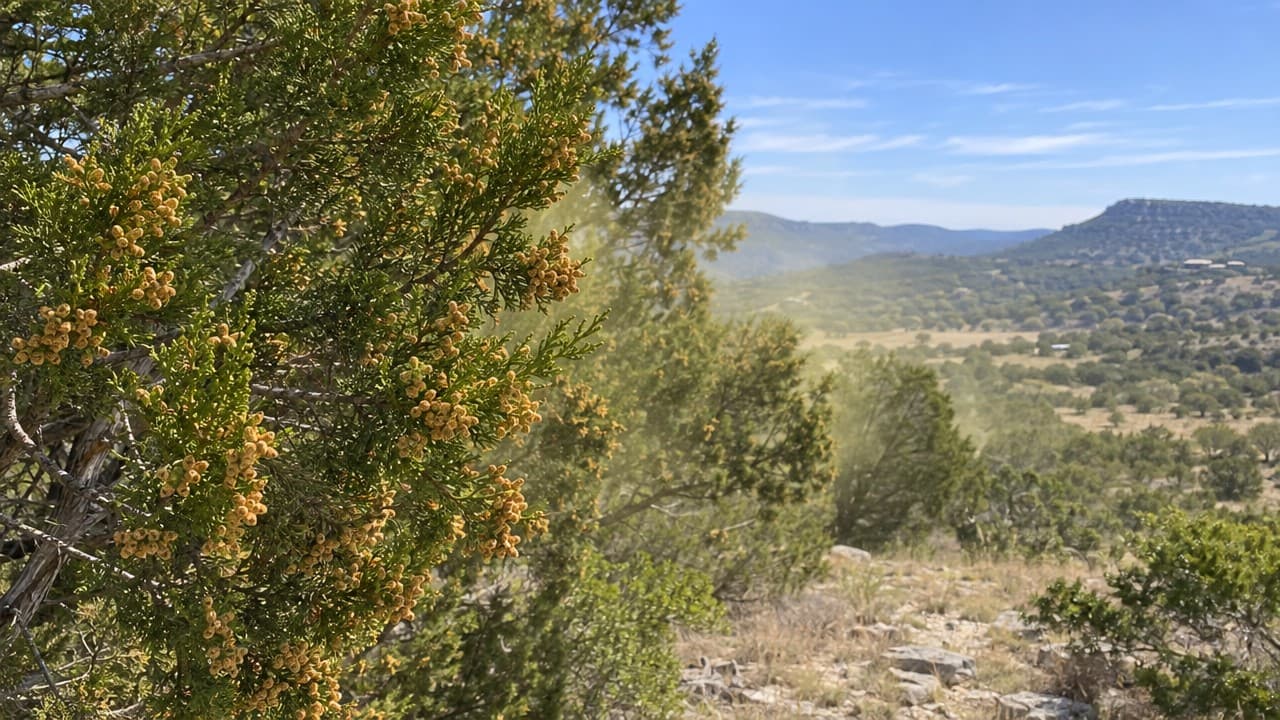
It's a small, tough tree, rarely taller than 30 feet, that thrives on the thin limestone soils of Central Texas. Only male trees make pollen. AgriLife notes they turn golden in winter as their pollen cones fill. The female trees carry the blue berries.
Where it grows
The heart of cedar country is the Edwards Plateau. A 2017 study in PLoS One from the University of Tulsa describes its largest stands along the plateau's limestone slopes, with smaller ones in the Arbuckle Mountains of south central Oklahoma, the Ozarks of northwest Arkansas and southeast Missouri, and northern Mexico.
The Texas A&M Forest Service says cedar fever is worst in the Hill Country west of I-35, where junipers fill much of the canopy. In East Texas, a different tree, the eastern red cedar, pollinates at about the same time and can set off a similar reaction.
When is cedar fever season?
Cedar fever season runs through the heart of winter. The Forest Service says Ashe junipers usually start releasing pollen in mid December, peak in mid January and taper off toward the beginning of March. The PLoS One authors give a slightly tighter window of early December to early February. Cleveland Clinic says some people feel it as early as November and as late as March.
That timing is unusual. Few plants pollinate in winter, as the Forest Service points out, so cedar has the season mostly to itself.
Cold fronts set it off
Watch the weather. The dry wind and fast pressure changes that come with a cold front cause the pollen cones to burst open, according to the Forest Service, and on those days you can sometimes see pollen blowing off the trees. Its 2021 article notes that pollen release is most common right before and after a front moves through.
How far the cedar fever pollen travels
Farther than you'd guess. In the PLoS One study, researchers used DNA testing to confirm that juniper pollen caught in an air sampler in London, Ontario, in January 2014 was Ashe juniper, carried north from Texas or Oklahoma. An earlier detection in the same city was traced to the Edwards Plateau, about 1,500 miles away.
The authors note that trips that long are considered rare. The everyday lesson is simpler. The Forest Service advises against cutting down the junipers on your own land, because pollen from trees miles away will still reach you.
Cedar fever symptoms
Cedar fever symptoms look a lot like a winter cold. The Forest Service lists tiredness, a sore throat, a runny nose and a partly lost sense of smell. Cleveland Clinic adds sneezing, itchy and watery eyes, coughing, and a dulled sense of taste.
The name is misleading. Most people with cedar fever don't have a fever at all, Cleveland Clinic says, though some run a slight one.
Why it feels like the flu
Two things are going on. The first is timing. Cedar season lands right on top of cold and flu season, so it's easy to blame a virus. The second is the sheer amount of pollen. The Forest Service says the pollen itself isn't especially allergenic and that its concentration is what overwhelms the body. The PLoS One authors see it differently. They call Ashe juniper pollen highly allergenic, the main cause of hay fever in Texas, and comparable to ragweed. Either way, a lot of it reaches your nose at once.
Cold, flu or cedar fever?
A few clues help, though none of them is a diagnosis.
- Temperature. A fever above 101.5 degrees probably isn't from pollen, according to the Forest Service. That points to an infection.
- Mucus. Allergy mucus is usually clear and runny. Thick or colored mucus suggests an infection, the Forest Service's 2021 article says.
- Itch. Itchy, watery eyes and sneezing fit allergies better than the flu.
- Pattern. Symptoms that flare after cold fronts, year after year, and fade by spring point toward cedar.
If you're unsure, especially with a high fever or body aches, check with your doctor. A flu or COVID test answers a question that guessing can't.
Related trees and cross reactions
Mountain cedar has relatives around the world, and the immune system can confuse them. A 1999 study from the University of Texas Medical Branch identified the main allergen in mountain cedar pollen, called 'Jun a 1'. It's closely similar to the main allergens in Japanese cedar and Japanese cypress, and antibodies from people allergic to Japanese cedar also latched onto it. That suggests someone already allergic to Japanese cedar may react to mountain cedar on a first Texas winter.
Closer to home, the eastern red cedar of East Texas pollinates in the same window, as noted above. If cedar fever bothers you somewhere Ashe juniper doesn't grow, that tree may be the reason.
How to cut your exposure
You won't avoid cedar pollen in Central Texas. You can keep more of it outside.
- Track the counts and the forecast. The Forest Service suggests checking local pollen counts. A cold front on the forecast is a warning.
- Close up the house and car on high pollen days, and spend less time outside when counts are up.
- Upgrade your filters. The Forest Service recommends higher MERV filters in home and car air systems, plus an air purifier.
- Dry laundry in the dryer instead of outside, Cleveland Clinic advises. On dry, windy days, a mask, hat and sunglasses help if you have to be out.
Don't count on a rainy day indoors. A study at The University of Texas at Austin found that during rainy spells, cedar pollen inside campus rooms rose to nearly the outdoor level.
Testing for mountain cedar allergy
An allergist can confirm cedar fever with a skin prick test or a blood test, according to Cleveland Clinic. Testing matters if you're weighing immunotherapy, because treatment uses the specific allergens you react to, and Texas offers plenty of overlap between cedar, oak, grass and ragweed. Our guide to allergy skin tests vs. blood tests explains the difference.
Longer term options for cedar fever
Allergy medicine controls the symptoms while you take it. It doesn't change the allergy, so next December starts the same way. A 2022 review of mountain cedar allergy by allergists at the Wilford Hall clinic in San Antonio lists allergy shots, along with avoiding pollen and medicine, as a key part of managing it. Immunotherapy comes in three main forms.
Allergy shots (SCIT) have the longest record. The AAAAI describes shots once or twice a week for four to six months, then every two to four weeks for three to five years. Our allergy shots guide covers the schedule in detail.
Allergy drops or tablets (SLIT) go under the tongue at home. Cleveland Clinic mentions an under the tongue option for cedar fever. Our comparison of allergy shots, allergy drops and ILIT lays out how they differ.
ILIT is the shortest course, and for some people a faster alternative to allergy shots. An allergist injects FDA approved allergen extract into a lymph node, usually in the groin, using ultrasound to guide the needle. Giving the extract that way is an off label use. A course is typically about three injections over about two months. The 2008 trial that established ILIT studied grass pollen and compared three injections over two months with 54 shots over three years.
The mountain cedar ILIT trial
Mountain cedar has its own ILIT study. In a 2020 trial in the Annals of Allergy, Asthma & Immunology, 21 people with cedar allergy received three monthly lymph node injections of either FDA approved mountain cedar extract or a placebo, before the 2018 to 2019 season. The trial registry lists sites in Austin, Grapevine and San Antonio.
The extract group had fewer symptoms and used less allergy medicine than the placebo group, and scored better on 20 of 27 peak season days. Nobody had a serious or whole body reaction. Four people had mild reactions where they were injected. One result didn't move: cedar specific IgE, a blood marker of allergy, didn't differ between the groups.
It was a small, single season study, and the authors called it a proof of concept. The lead investigators were from an Austin allergy practice, and the paper lists Aspire Allergy & Sinus as their affiliation. Aspire's offices are listed on Open Air Allergy Network. ILIT research overall is promising but smaller than the research behind allergy shots, and results vary from person to person. The ILIT safety FAQ explains the FDA question.
Every form of immunotherapy takes time to build, so there's no reason to wait for next season to talk with an allergist.
Find an ILIT provider in Texas
To see practices offering ILIT in cedar country, search for an ILIT provider near San Antonio, or browse ILIT providers in Texas by metro area, including Austin and San Antonio. If you live in Austin, our Austin allergies guide covers what follows cedar season, from oak in spring to ragweed in fall.
Frequently Asked Questions
No. Cedar fever is an allergic reaction, so you can't catch it from someone or pass it on. Cleveland Clinic describes it as the immune system mistaking pollen for an invader. A real fever, especially one above 101.5 degrees, points to an infection instead, according to the Texas A&M Forest Service.
As long as the pollen is in the air for you, which is usually the whole winter season. Cleveland Clinic notes that some people have symptoms from November through March and that most improve once spring arrives.
Yes, and rain doesn't always help inside. A 2022 study at The University of Texas at Austin measured mountain cedar pollen in campus rooms during the 2015 season. On rainy days, indoor pollen levels came close to outdoor levels, and the room with the most pollen had a window and door that were opened often. A windowless storeroom had the least.
Mountain cedar usually starts releasing pollen in mid December, peaks in mid January and tapers off toward early March, according to the Texas A&M Forest Service. Cleveland Clinic says some people feel it from November into March.
Yes. Mountain cedar is the common Texas name for Ashe juniper (Juniperus ashei), a member of the cypress family that Texas A&M AgriLife notes isn't a true cedar. An Ashe juniper allergy, a juniper pollen allergy and cedar fever all describe the same reaction.
The dry wind and sudden pressure changes of a front make the trees' pollen cones burst open, the Texas A&M Forest Service explains, so pollen release peaks right before and after a front passes. A front in the winter forecast is a good cue to close windows and start your allergy medicine.
Yes. Ashe juniper also grows in the Arbuckle Mountains of Oklahoma, the Ozarks of Arkansas and Missouri, and northern Mexico, according to a 2017 PLoS One study, which also traced its pollen by DNA as far as Ontario, Canada. In East Texas, the eastern red cedar pollinates at the same time and can cause a similar reaction.
It might. A 1999 study found the main mountain cedar allergen closely resembles the main Japanese cedar allergen, and antibodies from people allergic to Japanese cedar recognized it. An allergist can test for mountain cedar before your first Texas winter.
It depends on the drops. The cedar fever drops sold in Texas grocery stores are homeopathic products, and the National Center for Complementary and Integrative Health says there's little evidence homeopathy works for any specific health condition. Allergy drops from an allergist are made from allergen extract, but the ACAAI notes they're used off label in the U.S., and the AAAAI says the only FDA approved under the tongue treatments are tablets for dust mite, grass and short ragweed, not cedar.
For relief this week, allergy medicine is the fastest route. Immunotherapy changes how your immune system responds, and ILIT is the shortest course, about three injections over about two months. A small mountain cedar ILIT trial found three lymph node injections eased symptoms compared with a placebo. If a fast allergy treatment course like ILIT interests you, use Find a Provider on OpenAirAllergyNetwork.com to locate an allergist who offers it.