
What Do Dust Mites Look Like? Pictures, Size and Bites

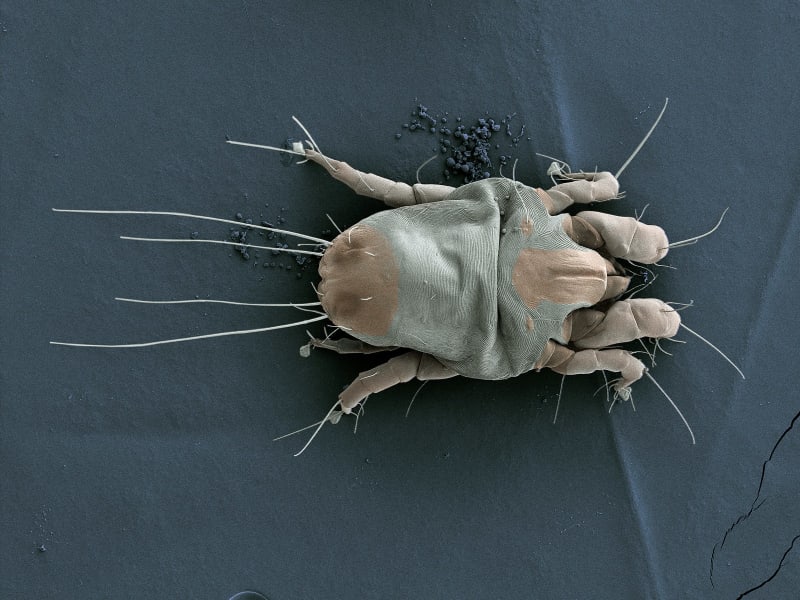
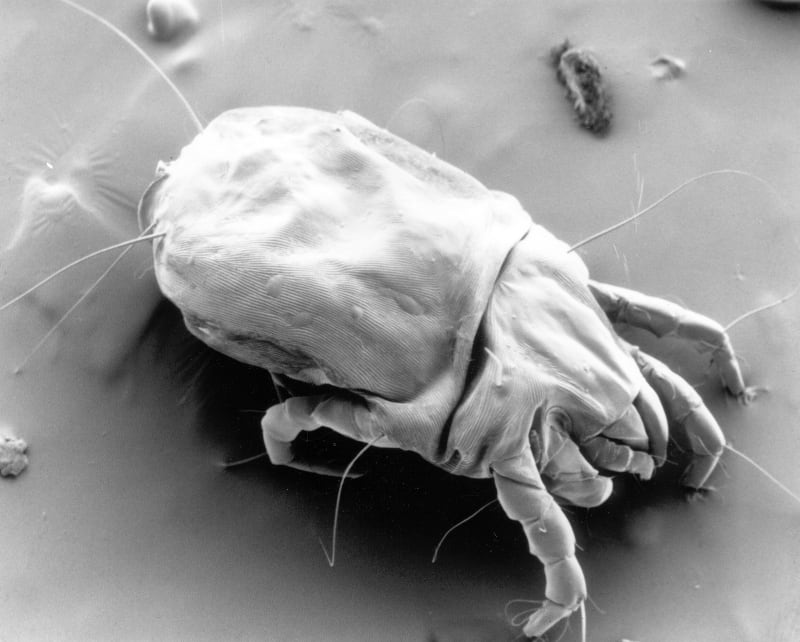
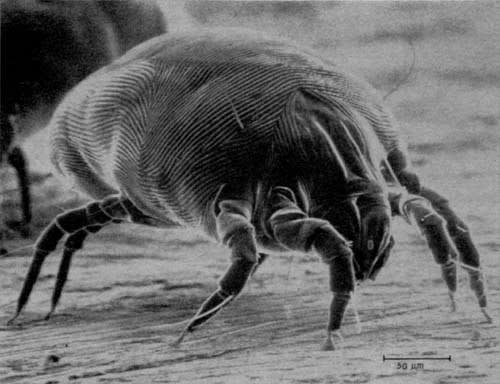
- Under a microscope, dust mites look like tiny white bugs with eight legs, about a quarter to a third of a millimeter long.
- You can't see dust mites with your eyes, so a bug you can watch moving in dust or bedding is something else.
- Pale specks in damp spots may be booklice, small striped hairy grubs may be carpet beetle larvae, and dark specks that jump may be springtails.
- Dust mites don't bite. Itchy bumps come from something else, such as carpet beetle hairs, bed bugs or scabies.
- Sneezing and a stuffy nose that can last all year and are often worst at home point to dust mites, and an allergy test can confirm it.
Under a microscope, dust mites look like tiny white bugs with eight legs. You won't see one that way at home, though. Each mite is only about a quarter to a third of a millimeter long, according to the Asthma and Allergy Foundation of America (AAFA), and Cleveland Clinic says they're too small to see with your eyes. So if you can see tiny bugs in dust or on your sheets, they aren't dust mites. They're more likely booklice, carpet beetle larvae or springtails, and none of them is what makes a dust mite allergy flare.
What dust mites look like up close
Dust mites are eight legged relatives of spiders, Cleveland Clinic explains. Magnified, the AAFA describes them as white bugs. The ACAAI says you'd need a microscope or magnifying glass to see one.
They live in the places you'd expect from something that eats skin flakes. Cleveland Clinic says they feed on the dead skin that people and pets shed. The AAAAI lists bedding, upholstered furniture and carpet as their main homes, and the AAFA says the bedroom usually has more of them than any other room.
You'll find them in nearly every home, no matter how clean, the AAFA notes. The exceptions are very dry or high altitude places.
Can you see dust mites on your bed or skin?
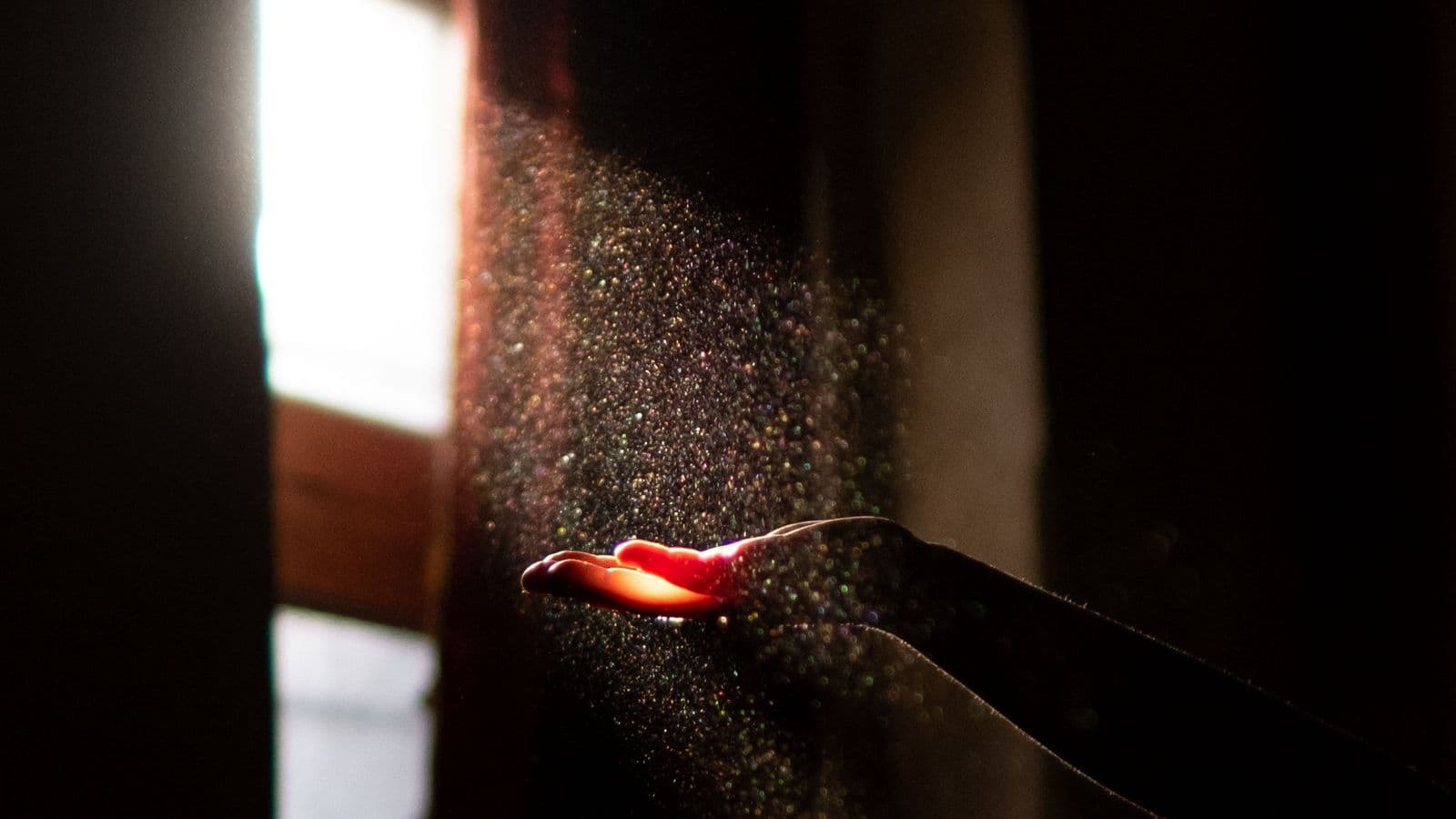
No. That's true on a mattress, a pillow or your arm. A bug you can watch crawling across your sheets is bigger than a dust mite, and so is anything you can pick off your skin.
What people with dust mite allergy react to isn't the mite you'd hope to spot. Cleveland Clinic says the allergy comes from proteins in the mites' waste and dead bodies, and the ACAAI notes that household dust can carry dust mite body parts and droppings.
Dust mites vs. bed bugs
Bed bugs and dust mites are easy to tell apart once you know the sizes. The EPA says an adult bed bug is about the size of an apple seed, 5 to 7 mm long, with a flat, oval, brown body when it hasn't fed recently. That's big enough to see easily, and many times longer than a dust mite.
Bed bugs also bite. The CDC says they feed on people's blood at night and hide in and around the bed during the day. Rusty blood spots on the mattress or nearby furniture and shed skins are signs of bed bugs. Dust mites, by contrast, are too small to see at all.
The tiny bugs you can actually see in dust
When people search for "dust bugs," "tiny white bugs in dust" or "little black bugs in dust," three household pests are worth checking first. The table puts dust mites at the top for comparison.
| Bug | What it looks like | Where you'll find it | Harmful? |
|---|---|---|---|
| Dust mites (for comparison) | Too small to see, about 0.25 to 0.33 mm. White with eight legs under a microscope | Bedding, upholstered furniture and carpet | Can't bite, but a common allergy trigger |
| Booklice | Pale, soft specks, 1 to 4 mm, no wings | Damp spots: books, boxes, near leaky pipes | No bites or disease |
| Carpet beetle larvae | Small hairy grubs, tan to black, look striped | Under carpeting, baseboards, furniture and seat cushions | Hairs can cause an itchy rash |
| Springtails | Dark (sometimes white) specks that jump | Damp areas, overwatered houseplants | Harmless |
Booklice are flat, pale, yellowish or grayish white insects, 1 to 4 mm long, with no wings, according to Utah State University Extension. Despite the name, they aren't true lice. They feed on mold, which is why they turn up around damp books, cardboard boxes and sweating pipes, the Utah State pest guide says. Lowering the humidity and improving airflow takes away their food.
Carpet beetles show up two ways. The adults are 1/16 to 1/4 inch long and range from black to multicolored, and they're often found on window sills, Utah State University Extension notes. So a little black bug on a window sill could be one. The larvae are small, hairy and tan to black with a striped look, and they can turn up under carpeting, baseboards and furniture, including under upholstered seat cushions.
Springtails are 1/16 to 1/8 inch long, mostly brown, gray or black, and they can leap several inches, according to University of Minnesota Extension. They gather where there's moisture or condensation. Drying out the area works better than spraying, and the university says pesticides aren't effective against them indoors.
Dust mite bites: what's really causing itchy bumps
There's no such thing as a dust mite bite. Cleveland Clinic is clear that dust mites can't bite. If you're waking up with itchy spots, a few other culprits are worth knowing.
Carpet beetle larvae are a surprising one. A 2021 report in a CDC journal described families in France whose itchy spots looked like bites but turned out to be allergic reactions to larva hairs lodged in the skin. The hairs can drift through a home on air currents. Penn State Extension notes that people usually become sensitive to the hairs only after years of exposure.
Bed bug bites are another possibility. Most people don't notice the bite marks until one to several days after the bite, the CDC says, and some people show no marks at all.
Scabies is a mite you can't see either, but it lives in skin, not dust. The CDC says the scabies mite burrows into the top layer of skin and causes intense itching, especially at night, along with a pimple like rash. It spreads mainly through long skin to skin contact. A rash like that needs a doctor's diagnosis, because no amount of dusting will clear it.
The real signs of a dust mite problem
Since you can't see dust mites, your symptoms are the better clue. The ACAAI lists sneezing, a runny nose, irritated eyes, a scratchy throat, coughing and wheezing. The AAFA adds itching in the nose, mouth and ears, and swelling around the eyes.
Timing is the other clue. The ACAAI says dust mite symptoms can last all year, and people with the allergy often feel worst inside their own homes. Symptoms often get worse during or right after vacuuming, sweeping or dusting, the ACAAI adds. If breathing gets hard or wheezing won't settle, get medical care right away.
An allergist can confirm a dust mite allergy, often with a skin test, the ACAAI explains, and occasionally with a blood test as well. Our guide to allergy skin tests vs. blood tests explains how each works. If the test comes back positive, the dust mite allergy guide has a five step plan for cutting mites at home, starting with your bed.
Longer term options for dust mite allergy
Allergy medicine such as antihistamines and corticosteroid nasal sprays, both on the ACAAI list of treatments, eases symptoms. Since dust mite symptoms can last all year, that can mean a long time on medicine. Immunotherapy works differently. Allergy shots work by gradually increasing a person's tolerance to allergy triggers, the ACAAI explains.
Allergy shots are the most familiar form. The AAAAI names dust mites among the allergens they treat, with a build-up phase of shots once or twice a week for four to six months, then maintenance shots every two to four weeks for three to five years.
Tablets dissolved under the tongue are another option the ACAAI lists. The dust mite guide covers the FDA approved dust mite tablet in detail.
ILIT (intralymphatic immunotherapy) is the shortest course and, for some people, a faster alternative to allergy shots. An allergist injects FDA approved allergen extract into a lymph node, usually in the groin (just below the waist, near the hip), an off label use explained in our ILIT FDA FAQ. A typical course is about three injections over about two months, the schedule used in a 2008 trial of ILIT for grass pollen allergy. Research for dust mites is small so far. In a 2021 placebo controlled trial in South Korea with 32 people allergic to dust mites, cats or dogs, ILIT didn't improve symptom or quality of life scores more than placebo, and one person had a severe reaction. That's worth asking about directly, including how many dust mite patients an allergist has treated with it.
Our comparison of allergy shots, allergy drops and ILIT puts the three side by side. To talk with an allergist about a shorter course of treatment, find an ILIT provider near you.
Image credits: dust mite seen from above, USDA Agricultural Research Service (public domain). Female dust mite, Matt Colloff, CSIRO, licensed under CC BY 3.0, cropped. House dust mite, U.S. Food and Drug Administration (public domain).
Frequently Asked Questions
No, not in any useful way. The ACAAI says dust mites are too small to see without a microscope or magnifying glass, and Cleveland Clinic says plainly that they're too small to see with your eyes, as does the AAFA. If you can see it crawling, it's a different bug.
About 250 to 330 microns. The AAFA puts them at a quarter to a third of a millimeter long, and a millimeter is 1,000 microns.
No. Bed bugs are much bigger, about the size of an apple seed (5 to 7 mm), and flat, oval and brown when they haven't fed, according to the EPA. The CDC says bed bugs bite people at night and feed on blood. Dust mites feed on shed skin and can't bite, Cleveland Clinic says.
Assume you do. The AAFA says dust mites live in nearly every home, no matter how clean, except in very dry or high altitude places, and the bedroom usually has the most. Since you can't see them, the useful question is whether you're allergic to them, and an allergist can answer that, often with a skin test.
There's no such thing as a dust mite bite. Cleveland Clinic says dust mites can't bite, so itchy bumps point to something else. Bed bugs are one possibility, and the CDC says most people don't notice their bite marks until one to several days later. A rash from carpet beetle larva hairs can look like bites too, according to a 2021 CDC journal report, and an itchy rash that's worse at night can be scabies, which needs a doctor's diagnosis.
Only if you're allergic to them. Cleveland Clinic explains that the proteins in dust mite waste and bodies are usually harmless, but some people's immune systems overreact to them, causing congestion, coughing, sneezing, itching and watery eyes. The ACAAI adds that dust mite allergy can also trigger asthma and make eczema flare.
Yes. The AAAAI names dust mites among the allergens allergy shots treat, usually over three to five years of maintenance shots. ILIT (intralymphatic immunotherapy) is a much shorter course of about three injections over about two months, though its dust mite research is still small. If you'd like to ask an allergist about it, use Find a Provider on OpenAirAllergyNetwork.com to locate an allergist who offers it.